Showing posts with label over-rated. Show all posts

Saturday, 27 August 2016

Review: A Darker Shade of Magic by V.E. Schwab

UK book cover of A Darker Shade of Magic by Victoria Schwab
This is the book Charlotte bought me for my birthday, and that I subsequently bought her for her birthday, and that we have referred to as 'that magic book' ever since. The title just will not stick in our heads even though we've both obviously gone through the processes of purchasing, receiving, opening and picking up said book. Strange. Pretty cover though.

Plot summary: Kell is one of the last travellers - magicians with a rare ability to travel between parallel universes connected by one magical city. There's Grey London, without magic and ruled by the mad King George III. Red London - where magic is revered, and where Kell was raised alongside the heir to the empire. White London - where people fight to control the remaining magic and magic fights back. And once there was Black London...

I think this book might have suffered under the weight of my expectations somewhat. I was so excited to read it. It looked so... different, such a unique and brilliant concept. And it is, I suppose. I love the idea of the three universes, all of which possess a City of London  and that one tavern, situated in the exact same space geographically and with the same river flowing through the middle. However, they all have different rulers, different politics and (key point coming up) different levels of magic. It's genuinely brilliant.

The problem is that the actual content is not so unique. Whilst the overall concept is great, the story is peppered with really, really tired fantasy tropes. I'm not going to list them as I can't do so whilst avoiding spoilers, but I did roll my eyes a few times when a plot point popped up that also popped up in the last twelve fantasy novels I read. It's fine, and the plot points in question weren't out of place or silly, it's just that I expected more.

The prose is good; the book is actually written quite well, content aside. The narrative flows and the dialogue is unstilted. I haven't read anything else by Victoria Schwab, but she seems to have a talent for writing at least.

The world-building is good, but could have been better. The three Londons are such an interesting idea that I'd have loved more time spent on developing them before the plot kicked off. It was that very concept that made me want to buy the book in the first place but then we never really got the detail that could have made it really wonderful. A slightly longer book would have been worth it, I think. Tell me more about King George! And White London! 

Is the character of... Lila... (I paid so little attention to her that I had to go back and check her name) really necessary? I can't help but feel that the book would be genuinely improved without her. I was hooked on the idea of sole, lonely traveller flitting between worlds and the blurb doesn't refer to the generic, strong, defiant-of-gender-roles character that no fantasy novel can do without. I could get on board with her if she served a purpose, but she doesn't. She's not particularly annoying but her presence changes the tone of the book into something much more YA-ish.  I will say that I appreciate the lack of romance - it could have been shoved in so easily and I respect the author for leaving it alone.

I quite like the ending - it's more subtle than most and it doesn't comply with the generic fantasy formula. I also like that it's actually a standalone book, which makes a pleasant change. No cliffhangers, no unfinished threads and no sudden revelations. The series does continue in the next book, A Gathering of Shadows, but this book is complete in itself. I can't decide if I'm going to buy it or not. I'm really, profoundly non-bothered about reading the story, but then the covers are so nice and they would look so pretty all lined up on my bookshelf...

I guess my main complaint about A Darker Shade of Magic is that it wasn't what I wanted it to be and I know that's not really fair. I was expecting dark and twisted, and featuring more of King George III, who was named in the title, after all. Instead it's fairly generic fantasy that is already starting to slide out of my head. It's just that an excellent over-all idea wasn't really developed properly, and was slightly dragged down by tired fantasy plot points. I enjoyed reading it, but I'm not sure I'll feel the need to pick it up again.

Read a more positive review of A Darker Shade of Magic at Ivy Book Bindings. 

Tuesday, 9 February 2016

Review: The Book of Lost Things by John Connolly

The Book of Lost Things book cover by John Connolly
When I picked this up last week, I couldn't remember a damn thing about it. I knew I bought it because Charlotte liked it (or she did in 2010, anyway - god, can you believe we were all friends back then!? Sidetracked, sorry...) and I eventually got round to reading it because my friend at work said it was her favourite book. The thing is though... I don't reeeeaaaaally get it.

Plot summary: High in his attic bedroom, twelve-year-old David mourns the death of his mother, with only the books on his shelf for company. But those books have begun to whisper to him in the darkness. Angry and alone, he takes refuge in his imagination and soon finds that reality and fantasy have begun to meld. While his family falls apart around him, David is violently propelled into a world that is a strange reflection of his own -- populated by heroes and monsters and ruled by a faded king who keeps his secrets in a mysterious book, The Book of Lost Things.

Taking readers on a vivid journey through the loss of innocence into adulthood and beyond, New York Times bestselling author John Connolly tells a dark and compelling tale that reminds us of the enduring power of stories in our lives.


I didn't dislike this book (it's amazing how many of my reviews feature that exact phrase and emphasis...) and I didn't struggle to pick it back up again at any point, but I wasn't exactly over-interested either.

It starts out really well and I actually fell fairly in love with it. David's mother passes away after a long illness and his only solace is in books. After a while you start to wonder if David is really doing alright, as he starts to hear his books talk to him. There are some beautiful passages and books and why we love them, and the different personalities of his books. It's told in an informal, chatty tone and it was honestly quite magical.
'The stories in books hate the stories in newspapers, David's mother would say. Newspaper stories were like newly caught fish, worthy of attention only for as long as they remained fresh, which was not very long at all. They were like the street urchins hawking the evening editions, all shouty and insistent, while stories- real stories, proper made-up stories-were like stern but helpful librarians in a well-stocked library. Newspaper stories were as insubstantial as smoke, as long-lived as mayflies. They did not take root but were instead like weeds that crawled along the ground, stealing the sunlight from more deserving tales.'
Then, unfortunately, the more fantastical side of the story happened.

I think I have actually managed to pin down why I was so under-whelmed by this book and it's purely because I never actually felt or cared about anything. This, in turn, is for three reasons.

1) David

David is twelve years old and likes his books. He doesn't go outside much and his main preoccupation is how much he dislikes his little brother. He's a bit wet, to be honest.

But when people start eating each other alive or women guillotine themselves down the middle, he's just fiiiiiiine. The Book of Lost Things is actually very graphic almost throughout the whole book and few details are spared, yet David is never, scared, emotional, hysterical or nauseated. Sure, the narrative may mention in passing that he was a bit freaked out, but he just didn't seem bothered. And if the protagonist isn't bothered, well then, I'm not going to be bothered either.

2) The Patchwork

This was the main issue for me I think. This book is very... linear. As in, they go to Point A, and then they go to Point B, and then they do Thing C. There's no... flow, really. An event happens, it's dealt with, and then they move onto the next one and it's never mentioned again.

You could argue that this effect was intentional as it creates a perception that David is walking through the seperate fairytales, which never merge into each other, after all. Either way, it didn't work for me.

3) The Theme

As previously mentioned, this book is quite graphic. It's gory to the point where I wondered if it was strictly necessary, and I look at pictures of dead people for a living.  

But the thing is, the overall moral of the story is so mind-numbiingly twee that it really didn't gel at all. You have the mismembered women on one hand... and the cutesy Labyrinth-esque theme on the other? PICK A TUNE AND WHISTLE IT.

_______________________________________________________

The other thing (because I just haven't mentioned enough Things yet) about The Book of Lost Things is the size of it. At first glance, it's a fairly substantial book. Not huge, but not laugh-about-it-to-your-friends small. But then the book just kind of ends... and the essays begin. They're fine, they're about fairy tales and there are some reading group questions, etc etc, but they take up a huge chunk of the book. See the photo on the right? That's where the story stops.

LATER: Oh God damn it, I nearly forgot about that bloody stupid ending.

I know I've done it again and railed about a book I didn't actually dislike. It's probably my own fault for having such high expectations. It's not a bad book; it's clearly just not for me. 

Read Charlotte's much more positive review of The Book of Lost Things here. 
 

Thursday, 30 April 2015

Review: The Rosie Project by Graeme Simsion

Book cover of The Rosie Project by Graeme Simsion
So I've spent the last three months pretty much solely writing about War & Peace. It's not that I wanted Booking in Heels to become a Tolstoy-only zone, but between starting a new job and desperately trying to get the read-a-long posts up, there wasn't a whole lot of time to talk about other, lighter books.

But now I'm finally freeeeee (if no less tired) and able to talk about books that may actually interest people. Perish the thought.

Plot summary: Don Tillman, professor of genetics, has never been on a second date. He is a man who can count all his friends on the fingers of one hand, whose lifelong difficulty with social rituals has convinced him that he is simply not wired for romance. So when an acquaintance informs him that he would make a “wonderful” husband, his first reaction is shock. Yet he must concede to the statistical probability that there is someone for everyone, and he embarks upon The Wife Project. In the orderly, evidence-based manner with which he approaches all things, Don sets out to find the perfect partner. She will be punctual and logical—most definitely not a barmaid, a smoker, a drinker, or a late-arriver.

Yet Rosie Jarman is all these things. She is also beguiling, fiery, intelligent—and on a quest of her own. She is looking for her biological father, a search that a certain DNA expert might be able to help her with. Don's Wife Project takes a back burner to the Father Project and an unlikely relationship blooms, forcing the scientifically minded geneticist to confront the spontaneous whirlwind that is Rosie—and the realization that love is not always what looks good on paper.


Of course I'm going to restart regular posting by trashing a book everybody loves. Of course. 

Well, no. I wouldn't go so far as to say that I even disliked The Rosie Project really and so I'm not going to 'trash it' as such. It has a unique concept and it's meant to be a light-hearted and fun romance. It's just that for me, it's slightly over-rated and caused me to raise an irritated eyebrow at times.

Graeme Simsion writes quite well - the prose flows well, in a light quirky way, and it's hard to put the book down once you start reading. The plot could be an interesting one too - staid, reserved Professor decides that he can use logic and reasoning to find a partner, only to have his project contradicted when he's confronted with a wild, rebellious woman that rationally shouldn't interest him at all. Sounds great.

The problem is, for such a concept to work you need to invest an awful lot into the characters... and that just doesn't happen here. Let's start with Rosie, because she's easier. And alsoprofoundly average in every way. She is neither boring not interesting, she's just sort of... there. Don't get me wrong, it's a bit of a twist to have the female love interest in a romantic novel be the flat one, but I was thinking maybe at some point we could really push the boat out and have two fleshed out charcters?

Alright, let's get to the real problem. Don Tilman has some sort of mental health issue, and there's a heavy implication that he's on the Autism Spectrum somewhere. I mean, they say that everybody is, but his behaviour is severely impacted. Think of him as Sheldon Cooper-esque.

The message I took from this book is that everybody with Asberger's or High-Functioning Autism or whatever are hilarious. It's okay to laugh at them. Don Tilman is obviously exaggerated to the effect that he's not a believable character at all, but it really does give off a vibe that everybody that suffers from these genuine mental illnesses are clowns.

Oh, but they're also geniuses. Because of Don's mental health, he's wonderful at science but can also instantly teach himself black-belt karate from a book, learn expert high-level bartending in a few hours and can be an expert dancer, again from reading a book. So, to clarify, Asberger's sufferers are basically loveable buffoons who have plugged in to the Matrix. 

Believe it or not, that's not what bothered me. I know, right? And you thought we were done. But no. What really offended me was that, apparently, if you just explain to somebody with Asberger's that what they're doing isn't rational, they can just... stop. Isn't that nice? I can't believe that the mental health teams across the world haven't reached this ground-breaking conclusion yet.

I get that it wants to end on a happy note; that Rosie is good for Don and brings him back to Earth, I do. And I'm sure that, for some sufferers, the right person can help stabilise their mental health. It just doesn't work the way that The Rosie Project implies.


I know a lot of you will think I'm over-reacting and that's fine. This is a light-hearted, fun book that I understand wasn't intended to be a wider analysis of mental health issues. But I'm sensitive to stereotypes of OCD, Asberger's, Bipolar Disorder, etc, and books like this, fun though they may be, really don't help.

Climbing down from my soapbox and putting aside the above issues, I still don't really understand the hype surrounding The Rosie Project. It didn't make a lasting impression as the ending is very rushed and weak, so as a result I feel profoundly 'meh' about this book and won't be reading the sequel.   

Read a more balanced review of The Rosie Project at Devouring Texts.

Saturday, 4 April 2015

Review: Station Eleven by Emily St. John Mandel

Book cover of Station Eleven by Emily St John Mandel
I read this book two whole months ago. Since then, my daily life has been taken over by a demanding new job and my reading life has been taken over by War & Peace. However, due to the gloriousness that is Easter Weekend, I've had some time to myself and I feel able to finally talk about Station Eleven. You, my friends, are in for a mildly indignant treat.

Plot summary: What was lost in the collapse: almost everything, almost everyone, but there is still such beauty.

One snowy night in Toronto famous actor Arthur Leander dies on stage whilst performing the role of a lifetime. That same evening a deadly virus touches down in North America. The world will never be the same again.

Twenty years later Kirsten, an actress in the Travelling Symphony, performs Shakespeare in the settlements that have grown up since the collapse. But then her newly hopeful world is threatened.

If civilisation was lost, what would you preserve? And how far would you go to protect it?

This book was recommended to me by almost everybody - I've seen glowing reviews, the Waterstones cashier was raving about it at the cash desk and an acquantaincey work colleague sort-of grudgingly admitted that he quite liked it. I'm also perfectly aware how many awards this thing has won. I... this does not make a lot of sense to me.

It was sold to me as a unique story about the struggle to retain our culture and therefore (arguably) our humanity, after a disaster of epic proportions. This is a perfect idea for a book - so many books concentrate on actually surviving, which is understandable but not particularly ground-breaking anymore. Unfortunately, Station Eleven reads exactly like one of those novels - a fairly generic post-apocalyptic novel in which some of the characters just happen to be Shakespearean actors. The plays themself (and other references to culture) are an incredibly minor part of the story, which mostly revolves around the usual hunts for food, Doomsday Cults and the fight for survival.

I mean, there's nothing wrong with that. I like a good post-apoc as much as the next person. There's just nothing particularly interesting or unique about it either. By two thirds of the way through, I just wanted to finish it and move on to something, ANYTHING, else. To put this into context, I was looking forward to going back to War & Peace. I know, right?

There are multiple POVs here and some of them are really interesting. There's Kirsten who idolises the actor she saw die on stage as a child, Clark who's running a sort-of museum in an abandoned airport, and Jeevan who was one of the first survivors, to name just a few. The problem is that each character is given far too much 'screen-time' in one sitting and so by the time we've circled back to a previous character, you don't care about them anymore. Essentially, I suppose I'm saying that Station Eleven needed to be longer... or shorter. Either spend more time building up the characters, or let us cycle back to them quicker.

The ending was... well, there actually wasn't one. The book just kind of stopped. Honestly, it felt as though the author just went 'oh, and they all match up because of this...' and then wandered off to put the kettle on. It's very wishy-washy and I was expecting more after such a lengthy and thorough build-up. Don't get me wrong, I was pleased that I was able to put the damn thing away but I'd still been harbouring a sneaky hope that I was about to be blown away by an epic ending. I was not.

It actually reminds me a lot of Cloud Atlas, now I think about it. There are too many strands and it tries so damn hard to be clever and link them all up that it ends up failing to develop any of them properly.

You've probably gathered that I wasn't a huge fan of Station Eleven, although I'm willing to admit that my high expectations didn't help. I just found it to be rather pretentious, over-ambitious and to be honest, slightly boring.

Read a more positive review of Station Eleven at Curiosity Killed the Bookworm.

Saturday, 28 February 2015

Review: The Bone Season by Samantha Shannon

Book cover of The Bone Season by Samantha Shannon
I know, right? Who knew I was actually able to write posts about books that aren't War & Peace? I do feel like I'm being unfaithful to it slightly, but on the bright side at least it means I can catch up on my backlog of reviews. Even though I should be reading epic Russian literature right now... *hides from this week's unread page count*

Plot summary: Nineteen-year-old Paige Mahoney works in the criminal underworld of Scion London. Her job: to scout for information by breaking into people's minds. For Paige is a dreamwalker, a clairvoyant and, in the world of Scion, she commits treason simply by breathing.

I'd heard amazing things about The Bone Season and the recently released sequel, The Mime Order. It's supposed to be 'the next Harry Potter' (along with every other fantasy book series ever) due to it's uniqueness and general awesomeness. I'm sure these things would be true if I understood a damn thing it was talking about.

At the beginning it was almost like reading a textbook - there was a huuuuge infodump about people, acronyms, types of powers, etc. and it really wasn't subtle at all. The explanations (such as there were) weren't woven into the story, we were just treated to rather large essays of text that didn't really make it any clearer anyway.

I barely understood the world that Paige lives in, so when the action started almost immediately, I didn't really care because I didn't understand the meaning or the implications. Far, far too much happens in the first few chapters - I was texting Charlotte almost incessantly whining (in capital letters, naturally) that I didn't understand. 

When I went online to check that this is the first book in the series (yes, it is that confusing) I found out that there's actually a glossary of terms at the back. It's not that useful as the words I wanted to look-up weren't even there, but it also makes no sense no have it at the back. I'd never have known it existed if a fellow reader hadn't mentioned it in passing. It seems rather lazy to bung a glossary in, instead of actually explaining what the feck you're talking about.

But then, this book is rather lazy. The prose is actually quite well-written, but every so often something 'clunks' in your head that makes you wonder how well this has actually been checked over. It's only the small things (like characters miraculously being aware of something they have no way of knowing, or a character standing in a corner and then somebody sitting at the table next to them), but it is irritatingly frequent.

Paige herself is also rather annoying, in the usual theoretically strong female character way. You know, where the author tries to make her a role model and she's actually just really mean? She shouts at everybody, is generally ungrateful for any help she receives and pretty much refuses to listen to anything/anyone that isn't her own ego. 

Lastly, the passage of time is explained very badly and this is quite the pet hate of mine. It seems as though they've only been around for a week or so, but then the prose suddenly announces (as subtly as always) that nine months have passed and it's incredibly disorientating.

I just don't understand how this series can possibly be dragged out into seven books - three seems like it would be more than enough. Obviously I have no idea where the author intends the story to go, but that's hardly surprising considering I barely understood where this story went.  

It's probably fairly obvious by this point, but I did not like The Bone Season. It was written well and probably had some interesting ideas, but it didn't take the time to explain them. There's absolutely nothing subtle about this book - not the plot, the info dump, the characters or the relationships - and I'd have infinitely preferred a slower pace and less action with more world-building.

Read Charlotte's more positive (and more eloquent) review of The Bone Season here.

Sunday, 12 October 2014

Review: Atonement by Ian McEwan

Movie book cover of Atonement by Ian McEwan
After I finished reading Atonement, I sent out wary feelers to my Reading Friends to see if I was the only one who felt this way. Apparently I am.

Warining for very strong language below... taken straight from the book, I might add.

Plot summary:
On the hottest day of the summer of 1934, thirteen-year-old Briony Tallis sees her sister Cecilia strip off her clothes and plunge into the fountain in the garden of their country house. Watching her is Robbie Turner, her childhood friend who, like Cecilia, has recently come down from Cambridge.

By the end of that day, the lives of all three will have been changed for ever. Robbie and Cecilia will have crossed a boundary they had not even imagined at its start, and will have become victims of the younger girl's imagination. Briony will have witnessed mysteries, and committed a crime for which she will spend the rest of her life trying to atone.

As it turns out, I had absolutely zero idea what this book was actually about before I started reading it. I was expecting a reasonably generic, 'coming of age,' family saga, but I watched the film trailer when I was a quarter of the way through the book and appaaaaaaaaarently not. There's lots of drama. And also children that can't act, but that's (almost) beside the point. 

I found Atonement to be surprisingly accessible when I had expected it to be dry and a little dull. The prose was fine, if a little purple, but unfortunately it just can't compensate for the sheer awfulness that is the rest of the book.

The main problem with this book lies with Briony, the protagonist. I would normally despise her and have a little rant about how awful she is, but I actually have no feelings about her. Do you know why? Because she is completely unbelievable as a character. Firstly, no eleven year old speaks like that. Even adults don't philosophise as pretentiously as she does.
She raised one hand and flexed its fingers and wondered, as she had sometimes before, how this thing, this machine for gripping, this fleshy spider at the end of her arm, came to be hers, entirely at her command. Or did it have some little life of its own? She bent her finger and straightened it. The mystery was in the instant before it moved, the dividing moment between not moving and moving, when her intention took effect. It was like a wave breaking. If she could only find herself at the crest, she thought, she might find the secret of herself, that part of her that was really in charge.
Oh my God, shut up. Does it sound like an eleven year old came up with that? Anyway, secondly, her actions make no sense. I understand she was young and naive and all that, but the reasonings given for her are silly and unrealistic. I've never read such a narcissistic, self-important character - I understand the need for flawed characters, but this is too far and therefore I can't take it/her seriously. The pretentious, grandiose ramblings of a learned philosopher professor just don't fit with her OTT naivety.
Her mother was forty-six, dispiritingly old. One day she would die. There would be a funeral in the village at which Briony's dignified reticence would hint at the vastness of her sorrow. As her friends came up to murmur their condolences they would feel awed by the scale of her tragedy. She saw herself standing alone in a great arena, within a towering colosseum, watched not only by all the people she knew, but all those she would ever know, the whole cast of her life, assembled to love her in her loss.
ARRRGH. But even now, I'm not annoyed with Briony - I'm annoyed with the writing. Sometimes it's just bewildering. At one point, it says, 'He caught a whiff of underarm perspiration, which put him in mind of freshly cut grass.' Hmm? Sweat reminds you of grass. Well, alrighty then.

The timeline is very jumpy, discussing her feelings throughout the trial before anything even remotely relevant has happened. This can work in some novels, but here it didn't particularly help that I didn't care what her feelings were.

I'm not usually a fan of soldiers-in-the-trenches descriptions so I might be a little biased, but I don't understand the purpose of Part Two. It contributed nothing to the plot as it didn't make a blind bit of difference whether anybody went off to war or not. Book Three would have been exactly the same regardless so it just seemed like a dreary piece of filler fiction.

I also don't like the ending, but I doubt that will come as a massive surprise to you at this point. There's no conclusion and no answers - what did she decide to do? Is the issue resolved? What happened? I was also disappointed In Briony during the epilogue - I had somewhat higher hopes for her, but they were eventually dashed against the Rocks of Unbelievability.

I aware and have always been aware that Atonement was written and published 2001, and yet I can't get it out of my head that this is a classic book from the 1940s or thereabouts. Naturally then, it shocks me when it frequently uses words like 'cunt,' but I think it's meant to shock readers which automatically irritates me. It's cheap.  

So this is obviously a fairly neutal review. Bet you're amazed at how impartial and unbiased I am. I do have to admit that Atonement has stayed with me during the month between reading it and writing this review, but not in a good way. If Briony had been slightly less... well, we won't go into that again, but if she had been written better and Part Two had a purpose, it could have been an interesting the novel. The premise had promise (ooh. That's my new favourite phrase) but it's just so over-the-top that I couldn't take it seriously.

Read an infinitely more positive review of Atonement at Book Addicted Blonde. 

Tuesday, 9 September 2014

Review: The Goldfinch by Donna Tartt (DNF)

Book cover of The Goldfinch by Donna Tartt
I feel like this review isn't going to go well... in defence, I spent A MONTH OF MY LIFE on The Goldfinch and was still only two third of the way through, so I feel reasonably justified in drawing a line under it.

Plot summary: Aged thirteen, Theo Decker, son of a devoted mother and a reckless, largely absent father, miraculously survives an accident that otherwise tears his life apart. Alone and rudderless in New York, he is taken in by the family of a wealthy friend. He is bewildered by his new home on Park Avenue, disturbed by schoolmates who don't know how to talk to him, tormented by an unbearable longing for his mother, and down the years he clings to the thing that most reminds him of her: a small, strangely captivating painting that ultimately draws Theo into the criminal underworld.


As he grows up, Theo learns to glide between the drawing rooms of the rich and the dusty labyrinth of an antiques store where he works. He is alienated and in love - and his talisman, the painting, places him at the centre of a narrowing, ever more dangerous circle. 

I loved The Secret History - the rambling yet beautiful prose, the odd tangents into classical mythology, the unlikeable but fascinating characters... it just worked perfectly and I was hooked. No wonder then that I was so excited about The Goldfinch that my partner's parents bought me a signed copy for Christmas last year. It's beautiful - a huge hardback with a little flap instead the cover that hides a golfinch, and a lovely looping signature. Bliss.

Except not. There's no getting around the fact that I just didn't like this book and I feel hugely let down by it. I literally spent a month trying to read it (without even reading another book alongside) and I just couldn't bear it anymore. I hate saying this because I know how much of a philistine I sound, but it's boring.

I don't mind books where nothing happens. I'm quite happy to be swayed by lovely prose and interesting characters, but 'slow' books are not necessarily good just because they happen to be literary. I dreaded picking up The Goldfinch and traipsing through page after page of irritating domesticity.

That's the key point, I think - it's far too domestic, much more so than The Secret History. It's about parents and divorce, with very little about the goldfinch portrait until roughly halfway through the book. Which is long, by the way. It starts out well but the second quarter is just the main character sulking around Vegas with his father and stepmother. For a boy with so many alcohol and drug dependency issues, he's surprisingly uninteresting and a cliche.

I liked Hobie and his shop - the one rounded and believable character. Those small parts gave off a lovely atmosphere and I could happily have jumped into the book and lived in that antiques workshop. In a way though, it just made me sigh all the more when we were dragged back to follow what's-his-face (Theo?) in Vegas.

I didn't finish this book, so maybe it gets better. I've read a lot of reviews of people that read the whole thing in a few days because they were so enthralled, and no doubt they'll shake their heads and mumble about how I didn't 'get it.' To be fair though; I didn't.

Read my review of A Secret History or read Laura's more positive review of The Goldfinch here.

Monday, 17 March 2014

Review/Rant: Tess of the d'Ubervilles by Thomas Hardy

Book cover of Tess of the d'Ubervilles by Thomas Hardy
So it's a little known fact that I write my review notes in the colour I deem most appropriate for that particular book, based on usually nothing more than a passing whim - red for FEED, orange for Mr Penumbra's... and so on. Do you know what colour I chose for Tess of the d'Ubervilles? Black. Blackest black black black black black.

Plot summary: The chance discovery by a young peasant woman that she is a descendant of the noble family of d'Urbervilles is to change the course of her life. Tess Durbeyfield leaves home on the first of her fateful journeys, and meets the ruthless Alec d'Urberville. Thomas Hardy's impassioned story tells of hope and disappointment, rejection and enduring love.

The following review will contain spoilers for Tess of the d'Ubervilles by Thomas Hardy, mainly because I want to rant.

Also contains strong language, for said reason.

This seems to be a complete love it or hate it book. Everybody seems to have an opinion about Tess, whether it's a heart-breaking novel of tragedy and perseverance or a whiny novel about a pathetic protagonist (and some fields). I'm no exception and while I conclude that it does have good points, they were vastly overshadowed by my desperate need to hurl myself out the nearest window.

See? Blackest black black.
Tess of the d'Ubervilles consists of lenghy essays about farming techniques and abstract philosophical ramblings, interspersed with the most depressing story since Les Miserables, and at least the clue is in the name with that one.

Since I've already done a spoiler warning, I figured I'd summarise the plot for y'all:
  • Tess' horse dies a painful death. Tess blames herself.
  • Tess goes to work as a chicken lady, where she gets raped by Alec. Tess blames herself.
  • Tess has a baby, which she dramatically names 'Sorrow,' just before it dies.
  • Tess goes to work on a dairy where she falls in love with a nice man. She is not worthy.
  • He loves her back and so she resolves to kill herself, naturally.
  • He proposes, but after the wedding he confesses that he's not a virgin as he consensually spent a consensual weekend of consensual sin with a consensual woman.
  • Tess confesses she was raped.
  • Angel is shocked and disgusted by her sin. Tess blames herself.
  • Angel eventually runs away to Brazil after a) days of being abusive and b) suggesting to Tess' friend that she be his mistress.
  • Tess blames her fucking self.
  • Tess' father dies and her mother emotionally blackmails her.
  • Tess runs into Alec and becomes his mistress.  
  • Angel changes his mind after a year and comes home, but finds Tess has finally seen sense (debatably).
  • Tess kills Alec.
  • Tess and Angel go on the run... until she is eventually executed after four pages of describing a field.
Now look. I know this all sounds frightfully dramatic - lots of action and suspense and whatnot. Except... no. It's just tedious and miserable. It's a long book to drag out those fifteen bullet points and that's done by tedious essays about morality and the importance of self-reflection.

Tess is the problem, as you may have guessed by my passive-aggressiveness. I just HATED her. She was so mind-numbingly sorry for herself when actually, everything was her own doing (except the rape, obviously). She could have fixed her problems by standing up for herself - even Angel said that he would have respected her more if she stood her ground. She's pathetic. PATHETIC.
So easefully has she delivered her whole being up to him that it pleased her to think that he was regarding her as his absolute possession, to dispose of as he should choose. It was consoling, under the hovering terror of tomorrow's separation, to feel that he really recognised her now as his wife Tess, and did not cast her off, even if in that recognition he went so far as to arrogate to himself the right of harming her.    
No. Just no. She's so pleased that he referred to her as his wife, that she's quite willing for him to harm 'his property.' He sleepwalks, picks her up and carries outside and she's genuinely thrilled at the idea that he's going to drown them both. I'm actually thumping the keys so hard it hurts my fingers right now.

What annoys me most is that she doesn't learn. There's no comeupannce (you know, aside from her eventual execution) and she never understands the importance of self-respect. She just trudges on, sighing dramatically and holding her hand to her head. 

Yes yes, it was a different time period. But the point is, I'm in this period and it aggravates me. I know Hardy was (theoretically) writing from a pro-Tess perspective about all the wrongs men did to her, but it doesn't stop her being the least likeable character in the whole of fiction.

Angel isn't much better - aside from the obvious double standards of 'hey, I spent a weekend with a random woman but I hate you for being raped' asshattery, he morally objects to her (unwilling) lack of virginity but is just fiiiiine when she murders somebody.

 
The ending doesn't make much sense either. I wasn't traumatised or heart-broken, just slightly bewildered. I mean... why kill him? Yes, he raped you but the time for revenging that was long past. You had a little whine that he lied to you but actually he didn't - he surmised to you that Angel wasn't coming back (a reasonable assumption under the circumstances) and you believed him because you are a fucking moron. You don't have to believe everything everybody suggests to you and then you don't have to kill them when you do.

It's out of character and non-believable. I mean, I understand the point is that she finally 'snapped' after all this hardship and took what she wanted instead of what others desired for her... but it still doesn't fit. The very ending itself is incredibly anti-climactic - there's more focus on a stray field than anything else. 'Oh by the way, Tess was executed... but look at this greenery!'

It's suprisingly accessible and easy to read, content aside. There are some marvellous quotes and some beautiful prose, but they were overshadowed by the hugely irritating characters and over-emphasis on farming. I'm quite interested in what Thomas Hardy actually intended this book to say, because I know there's a message here. Either that or he really hated women.
In her misery she rocked herself upon the bed. The clock struck the solemn hour of one, that hour when fancy stalks outside reason, and malignant possibilities stand rock-firm as facts.
We're done here, I think. I'm glad I've read Tess of the d'Ubervilles but I can't particularly say that I enjoyed doing so. I could have dealt with the sad plot, but not with Tess herself. It's a lifeless trainwreck of misery. 

This book was:
So. I know at least one of you that loves it and at least one that hates it. Where do you stand on Tess of the d'Ubervilles?

Thursday, 21 November 2013

Review: Shatter Me by Tahereh Mafi

UK book cover of Shatter Me by Tahereh Mafi
When Shatter Me was first released, I was desperate for it. I stalked it for months before release but couldn't afford to purchase a copy. Finally, finally, some lovely person sent me a RAK... then I took more than a year to read it, obviously. And was it worth the wait? Was it everything I'd hoped and dreamed of? 

Nope, absolutely not.

Plot summary:  I have a curse. I have a gift. I'm a monster. I'm more than human. My touch is lethal. My touch is power. I am their weapon. I will fight back. 

No one knows why Juliette's touch is fatal, but The Reestablishment has plans for her. Plans to use her as a weapon. But Juliette has plans of her own. After a lifetime without freedom, she's finally discovering a strength to fight back for the very first time--and to find a future with the one boy she thought she'd lost forever. In this electrifying debut, Tahereh Mafi presents a riveting dystopian world, a thrilling superhero story, and an unforgettable heroine.  

It's not great. Or even 'good,' really. Maybe it suffered under the weight of my heavy expectations, but I didn't like the style, story, ending, characters or prose. In short, it doesn't have a whole lot going for it really!

The first thing I noticed is how gimmicky Shatter Me is. It has some interesting ideas, like how Juliette counts (objects, seconds, breaths) to pass the time in her cell, a habit which carries through into her narrative. It's written in the first person, as though you were actually in her head, and she's very flighty, jumpy and indecisive. To demonstrate this, strikethroughs are sometimes used to demonstrate how she changes her mind over and over during the space of just a few seconds.

Both these are great ideas that add a certain uniqueness to the story... but enough is enough. They go on far, far too long. Using actual numbers (4 instead of 'four,' for example) will always look out of place in the middle of a paragraph and will completely break my concentration, however much you want to emphasise that the girl likes to count. We get it. Shut up.

The strikethroughs are actually more irritating and persist much longer. They're not even part of the normal font; instead, they've gone to special effort to make it look handwritten. I completely agree that it adds to the manic tone and it fits Juliette's character, but again, it breaks the flow and isn't really necessary.

To me these two ideas summarise the essence of the book - gimmicky and difficult to focus upon.

The problem is, I understand the author is going for a stream of consciousness, babbling narrative, but I really struggled to read it. I ended up skimming even when I tried to pay attention. It's written in a way that doesn't require much skill at all - any flaws in your writing will be camouflaged by the surrounding 'quirky' errors. Seriously, use commas. It's not hard.

Coincidentally, whilst I was reading this, I discovered the meaning of the phrase 'purple prose,' which apparently means 'written prose that is so extravagant, ornate, or flowery as to break the flow and draw excessive attention to itself.' I swear those words were created for Shatter Me. It book tries so hard to sound arty and special that it ends up at the expense of coherence.


I don't know if I've actually spoken or if I'm actually still sitting here or if I'm actually 14 years old all over again all over again all over again and I'm screaming and dying and diving into a pool of memories I never ever ever ever ever
I can't seem to forget
I saw her at the grocery store. Her legs were standing crossed at the ankles, her child was on a leash she thought he thought was a backpack. She thought he was too dumb/too young/too immature to understand that the rope tying him to her wrist was a device designed to trap him in her uninterested circle of self-sympathy. She's too young to have a kid, to have these responsibilities, to be buried by a child who has needs that don't accomodate her own. Her life is so incredibly unbearable so immensely multifaceted too glamorous for the leashed legacy of her loins to understand.
There are no typos in the above quote. In my opinion, books can be arty and with beautiful prose... or not. Either way is fine, but mixing the two just doesn't work. You can't have a simple, fun story narrated by a babbling teenager (which isn't a bad thing, before you call me a snob), but then remove grammar and introduce enough flowery metaphors to drown Shakespeare. It does not work.

SPOILERS BELOW

I also need to talk about the ending. It's awful. Now, I'm the first to complain when people whine that such-and-such book has 'like totally ripped off' some other book/TV show/movie/whatever. There are a limited amount of stories around and sometimes there will be similarities.

Great. But Shatter Me IS X-Men. We're not talking an odd likeness here and there. Juliette is alone and daren't touch anybody and has therefore never loved. She ends up finding a whole bunch of friends just like her (but everybody has different powers) in a secret school/laboratory and they all run around in odd wetsuit-type costumes.

I want to bang my head against the desk SO HARD.

END OF SPOILERY RANT

Basically and concludingly, Shatter Me tries way too hard. I get what it was trying to do, but there are too many gimmicks and the 'purple' writing style just doesn't work. It feels like the second book in a series, I think, not the first - as if the Revolution (or whatever) has already happened and she's already been captured. It's different from most other YA dystopian novels in that respect, at least. But the end result is that I feel like I'm missing a connection to Juliette and the story, as it just couldn't hold my interest at all.

It doesn't help that the ending is so different from the tone of the rest of the book and it was laughably ridiculous. It's unlikely that I'll read the rest of the series because I just don't see it could go that I could be interested in.
    
For a more balanced review of Shatter Me, head over to A Tapestry of Words.

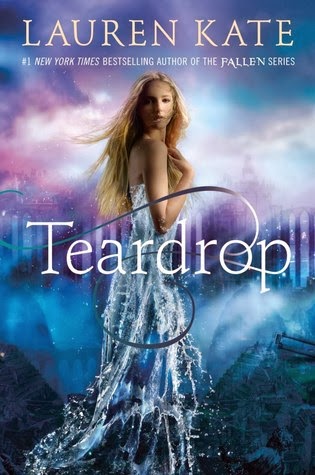
Review: Teardrop by Lauren Kate

Book cover of Teardrop by Lauren Kate
Teardrop was so obviously not for me that I considered just not reviewing it and, if I was merely apathetic about it, I probably would have let it go at that. Unfortunately I have such strong feelings about this book that I just have to review it properly. Well, I say 'properly,' but I probably actually mean 'angrily.'

This isn't going to go well.

Plot summary: Never, ever cry... Eureka Boudreaux's mother drilled that rule into her daughter years ago. But now her mother is gone, and everywhere Eureka goes he is there: Ander, the tall, pale blond boy who seems to know things he shouldn't, who tells Eureka she is in grave danger, who comes closer to making her cry than anyone has before.

But Ander doesn't know Eureka's darkest secret: ever since her mother drowned in a freak accident, Eureka wishes she were dead, too. She has little left that she cares about, just her oldest friend, Brooks, and a strange inheritance - a locket, a letter, a mysterious stone, and an ancient book no one understands. The book contains a haunting tale about a girl who got her heart broken and cried an entire continent into the sea. Eureka is about to discover that the ancient tale is more than a story, that Ander might be telling the truth... and that her life has far darker undercurrents than she ever imagined.

Genuinely and completely non-sarcastically (but just wait), it sounded like an interesting premise. Mysterious boy and dead mother clichés aside, I picked it up for the unique premise of the underwater mythology mixed with a girl who couldn't cry for fear of Bad Things happening. Great, awesome!

Except not. It's so achingly, mind-numbingly domestic. The actual magic-y aspects don't really form an integral part of the story until at least three quarters of the way through, and that's a generous estimate. It's hinted at, sure, but it's mostly the old male friend and the new sultry boy beating their chests at each other, to Eureka's natural delight disdain. I had zero interest. If I wanted to read about a teenage protagonist who had to choose between two equally terrible men, I could wander into Waterstones and pick up almost any book in the Teen section. It's just so over-done now.

The prologue doesn't help in that respect. I rant about prologues and epilogues so much that I'm not going to bang my head against that wall anymore today, but this prologue is kind of self-defeating. It tells you the end of the story! Because of this, I began the story already knowing who Ander is, why Eureka's mother died and why people are chasing her. Oops, there goes the mystery!

Eureka herself has to be the worst fictional character I have ever come across. I know her Mum has just died and I'm very sorry about that. But please, dear God, stop talking about it. She's unbelievably melodramatic - more so than Sloane in This Is Not A Test, and she tried to sacrifice herself to a zombie horde. She can't be in the school group photo because OMG MY MOM DIED and 'You know I don't like boys since MY MOM DIED. God, you are SO INSENSITIVE.' Also, it is not a 'death sentence' to sit at a lunch table with people. I hated this. Hated. I was so angry at it that I actually had to keep putting it down before it ruined my mood for the day.

Eureka felt tricked. A yearbook picture hadn't been part of her deal with Coach. She saw the photographer, a man in his fifties with a short black ponytail, setting up a massive flash apparatus. She imagined huddling into one of the lines alongside these other kids, the bright light going off in her face. She imagined the photo being printed into three hundred yearbooks, imagined future generations flipping the pages. Before the accident, Eureka never thought twice about posing for the camera; her face contorted into smiles, smirks, and air kisses all over friends' Facebook and Instagram pages. But now?
The permanence this single photo would imply made Eureka feel like an imposter. She imagined the lie of her high school resume - Latin Club, cross-country team, a list of honors classes. Survivor's guilt, the one extracurricular activity Eureka was interested in, was nowhere to be found. She stiffened so it wouldn't be obvious she was shaking.
It's bearable for two paragraphs, right? Well, almost. Now imagine 400 pages of that.

The other characters are fairly generic - boy-crazy but dependable best-friend, horrible step-mother (who actually seems like a fairly reasonable person), clueless father.... etc. Except we have to stop every time somebody new is introduced so we can be told what they look like and where they live in excruciating detail. It's not quite as bad as 'the main character looked in the mirror and saw XYZ looking back at her,' but it's close.

The writing itself is lazy. There are lots of instances where Eureka 'can't explain how she knew' and doing odd things 'by instinct,' presumably because the writing is too lazy to explain a character's action with a logical reason. And obviously Eureka can randomly understand some obscure iconography because she went with her mother to a xylography class at some point. That's lucky. And lazy.

My feelings about Teardrop are probably pretty clear by this point. I think I'm so annoyed because it could have been great - there's a unique premise that I've never seen even touched upon before, but unfortunately that wasn't where the focal point of the book seemed to be. Too much melodrama about silly things and too much shoddy writing. I don't think I'll be trying Lauren Kate again.

Read another review of Teardrop at Effortlessly Reading. 

Saturday, 8 June 2013

Review: Requiem (Delirium #3) by Lauren Oliver

UK book cover of Requiem by Lauren Oliver
Well, hasn't this been a rollercoaster of a series? And I'm not even talking about the plot here. I read Delirium and it was fine-ish. Then I read Pandemonium and adored it. Now I've read Requiem and we're actually worse off than we started! I had high hopes for this book as I was so impressed with the second in the series, but unfortunately it completely and totally failed to deliver.

Plot summary: Now an active member of the resistance, Lena has been transformed. The nascent rebellion that was under way in Pandemonium has ignited into an all-out revolution in Requiem, and Lena is at the center of the fight.

After rescuing Julian from a death sentence, Lena and her friends fled to the Wilds. But the Wilds are no longer a safe haven—pockets of rebellion have opened throughout the country, and the government cannot deny the existence of Invalids. Regulators now infiltrate the borderlands to stamp out the rebels, and as Lena navigates the increasingly dangerous terrain, her best friend, Hana, lives a safe, loveless life in Portland as the fiancĂ©e of the young mayor.

Maybe we are driven crazy by our feelings. Maybe love is a disease, and we would be better off without it. But we have chosen a different road.

And in the end, that is the point of escaping the cure: We are free to choose. We are even free to choose the wrong thing.


I should have learned not to read reviews of the books I didn't like by now. Unfortunately, I have not learned this and it usually results in a puzzled expression and squinty eyes as I attempt to fathom what I have missed. Lord knows I don't get it. There is so much wrong with this book. It has its good points, which are much the same as in Delirium and Pandemonium, but the glee, sobs and heart-wrenching angst that feature in other reviews seem to have passed me by entirely.

However, Lauren Oliver's unbelievable world-building talent does needs a mention. The society she has created in these books provides the foundation for the entire series, and there aren't many YA novels with a setting so believable and detailed as here. A lot of effort has gone into this and it shows. Genuinely, it's brilliant.

I just found Requiem a little... I don't know, gimmicky? The alternate chapter thing worked really well in Pandemonium; it was actually one of my favourite things about that book. Unfortunately that isn't a reason to force it into this one. Chapters alternate between Lena and Hana and it just doesn't work! Hana has barely been mentioned in the series since very early on, and there's no reason to feature her and her boring irrelevant life just to continue an alternating pattern trend. I didn't enjoy her chapters and didn't think she was really required at all.

Thinking about it, it was the characterisation on the whole that really let down this novel. They all seem kind of... flat. Clearly Alex is meant to be all aloof and mysterious, but he's just a cardboard cut-out of a Nothing character. Lena annoyed me quite a lot, which didn't help. She isn't fair to Julian at all, but apparently this is okay. He gave up everything for her, but all she can do is obsess over Alex for no apparent reason. I would genuinely like to shake her and, without getting on my high horse, it sends a terrible message to young girls about how to treat their boyfriends.

It is a lot more romance-orientated than the first two books, but that's understandable. It is the last book in a series about love, after all. Unfortunately there's not really anything to balance that out, despite the ongoing revolution. There's a lot of repetitive running from camp to camp and not actually doing a whole lot. Isn't that the prerogative of the second book in a series, usually?

Actually, that might have hit the nail on the head. Requiem feels like a second book. Aside from anything else, there's no ending! It just kind of... stops. Nothing is resolved. Without giving it away, there isn't a single sub-plot that is tied off. Genuinely, I actually had to go online and check there wasn't a final chapter on Lauren Oliver's website. I kept reaching for it to finish it, only to realise that, theoretically, I already had. This was the main point for me, I think. If you've reached the third book in a series, you've invested quite a bit of time. You at least deserve a proper ending.

I wanted and expected to like Requiem, but I just couldn't. There are too many faults with the structure, the plot and the characters. As I said above, the world-building is excellent but it just wasn't enough to save the book for me. Pandemonium was definitely the high part of the Delirium series, but unfortunately Requiem is the lowest - not ideal for a finale.

Regarding the series as a whole, I'm not sure what to tell you. If I based my recommendation on this book alone, I'd tell you to stay well clear. I'd like to recommend reading just the first two installments and stopping after Pandemonium, but that clearly doesn't make sense either. Alright then, my final conclusion is that it's definitely worth reading the first two for their own value, and then this one just to tie it off. Just don't expect a great deal from it.

Fin.

Read my reviews of Delirium and Pandemonium.  

Grab my Button

Booking in Heels
 

Booking In Heels Copyright 2008 Fashionholic Designed by Ipiet Templates Supported by Tadpole's Notez